
From Cape Fynbos to Your Teacup: Rediscovering South Africa’s Honeybush Heritage
12 November 2026 – An indigenous South African tea with a rich history, distinctive flavours and a growing body of scientific research is finding new appreciation among tea lovers. For food and sensory scientist Dr Brigitte du Preez, honeybush is much more than a refreshing cup of tea. It represents South Africa’s natural heritage, generations of traditional knowledge and more than 15 years of her own scientific research.
As the owner of Cape Fynbos Tea, Du Preez is passionate about introducing more South Africans to this homegrown treasure and showcasing the diversity of flavours found in the Cape’s indigenous fynbos.
Cape Fynbos Tea became the first honeybush tea brand to receive the Cancer Association of South Africa (CANSA) Smart Choice Seal of Recognition, a milestone announced in August 2022. The CANSA Smart Choice Seal of Recognition helps consumers identify products that meet CANSA’s evidence-based criteria, supporting informed choices as part of a balanced lifestyle.
For Du Preez, the recognition is particularly meaningful because of CANSA’s commitment to scientific research and evidence-based health education.
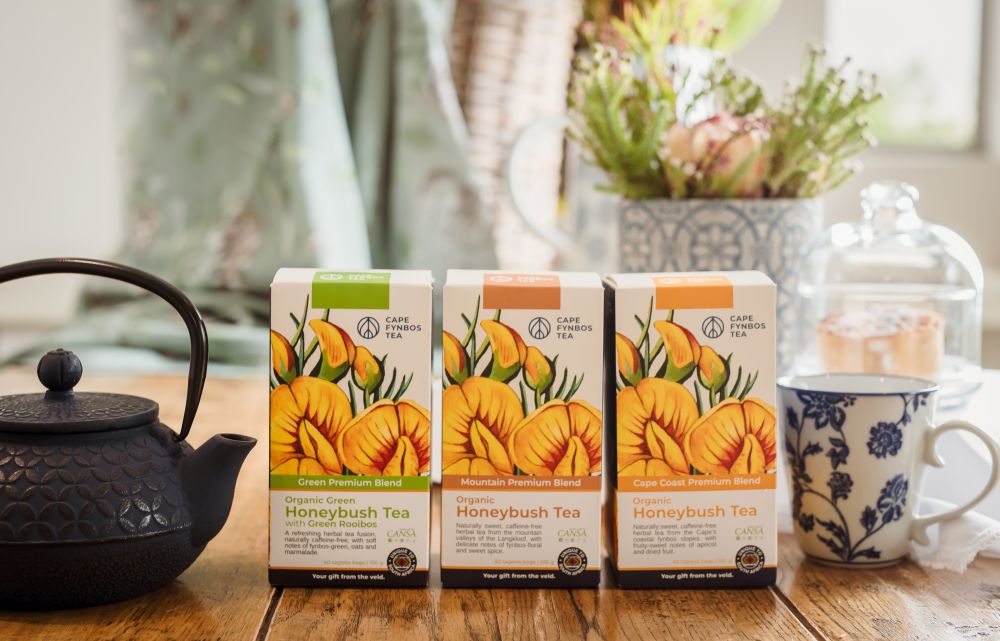
Cape Fynbos Organic Honey Bush Teas


A South African tradition worth rediscovering
Long before honeybush became a commercial product, it was gathered and brewed by communities in the Cape, with its heritage deeply rooted in the traditional knowledge of Khoi and San communities. Known for its naturally sweet taste and distinctive fynbos-sweet aroma, honeybush has been enjoyed for generations. In many households, a pot of tea would remain on the stove, ready to welcome visitors.
While its better-known cousin, rooibos, became a household favourite, honeybush remained something of a hidden gem.
Both teas are indigenous to South Africa and naturally caffeine-free, but honeybush has its own distinctive character. Made from the leaves and stems of Cyclopia shrubs found in the Western and Eastern Cape, it offers a range of flavours, from fruity-sweet to fynbos-floral.
Although honeybush has a long history of traditional use, its commercial cultivation and scientific development gained momentum only in the 1990s.
Research by the Agricultural Research Council (ARC), Stellenbosch University and other institutions has helped advance understanding of honeybush cultivation, processing, flavour and naturally occurring plant compounds.
From scientist to tea entrepreneur

Dr Brigitte du Preez
Growing up surrounded by the Cape’s fynbos-covered mountains, Du Preez developed an early fascination with the region’s extraordinary plant diversity. That interest eventually led to a PhD in Food Science at Stellenbosch University and a research career dedicated to understanding what makes honeybush so special. Her work has included developing scientific methods to evaluate the aroma, taste and overall sensory quality of honeybush tea. Today, she is putting that expertise into practice through Cape Fynbos Tea.
“Becoming the owner of Cape Fynbos Tea feels like a natural next chapter,” says Du Preez.
“After spending so many years researching honeybush, it’s incredibly rewarding to apply that knowledge to developing tea blends that people can enjoy every day.
“For me, the science remains important, but just as important is bringing together the right flavours to produce a beautiful tea that people genuinely enjoy drinking.”
Her premium collection includes three blends: Cape Coast, with fruity notes of apricot and dried fruit; Mountain, offering delicate floral notes and a hint of cinnamon; and Green, a refreshing blend of green honeybush and green rooibos. All three blends received Double Gold awards at both the 2026 Aurora International Taste Challenge and the 2026 SA Food and Beverage Awards.
Du Preez sources certified organic honeybush and rooibos from local producers, with a focus on sustainable cultivation and harvesting practices that support the growth of South Africa’s indigenous tea industry.
A naturally caffeine-free alternative
Beyond its appealing taste and aroma, honeybush offers consumers a naturally caffeine-free alternative to conventional tea and coffee. Its naturally sweet flavour also makes it enjoyable without added sugar, while its low tannin content contributes to a smooth, pleasant taste.
Honeybush has attracted scientific interest because of its naturally occurring plant compounds, some of which have demonstrated antioxidant activity in laboratory studies. Researchers have also investigated honeybush extracts for their potential relevance to women’s health and cancer-related research.
However, CANSA emphasises that laboratory findings do not mean drinking honeybush tea has been proven to prevent or treat cancer or other health conditions.
The CANSA Smart Choice Seal of Recognition identifies products that meet the programme’s criteria and should not be interpreted as an endorsement of honeybush tea as a cancer treatment.
Megan Pentz-Kluyts, Consulting dietitian to CANSA, says. “At CANSA, we believe that access to credible, science-based information empowers consumers to make informed lifestyle choices. Through our Smart Choice Seal of Recognition, we help consumers identify products that meet our established criteria, while encouraging a balanced approach to health and wellbeing.”
For consumers, honeybush can simply be enjoyed as a flavourful, naturally caffeine-free beverage within a balanced lifestyle.
CANSA Fact Sheet Honeybush Tea
A taste of South Africa in every cup
Du Preez hopes more South Africans will discover honeybush, appreciate its heritage and explore the different flavours it has to offer. Whether enjoyed steaming hot on a chilly morning or served as a refreshing iced tea with a slice of citrus on a warm summer afternoon, honeybush offers a uniquely South African tea experience.
“I would love more South Africans to discover its different expressions, understand its story and make honeybush part of their everyday tea ritual,” says Du Preez.
To discover the Cape Fynbos Tea range and find selected retailers, visit www.capefynbostea.co.za or www.faithful-to-nature.co.za/cape-fynbos-tea.
Apply to become a CANSA Seal of Recognition partner…
(For more information, please contact Lucy Balona, Head: Marketing and Communication at CANSA at email lbalona@cansa.org.za. Call 011 616 7662 or mobile 082 459 5230).
Queries CANSA
0800 22 6622 Toll Free
072 197 9305 English and Afrikaans (text only)
071 867 3530 isiXhosa, isiZulu, Sesotho, Setswana and Sepedi (text only)
CANSA Care Centres
Connect with CANSA on social media:


